Live chat for logistics software, on the integrations page.
Logistics buyers want to know whether you connect to their TMS, their carriers and their invoicing. Your sales team answers on the page, by chat or a browser call.
Free 30-day trial. No card, no automatic charge.


Shown with fictional companies and fictional people.
What slows a logistics software sale. And what changes on the page.
- Problem: Integration questions behind a form
- With GreetDock: Answer the TMS question in the thread, on /integrations.
- Inbox
- Problem: Buyers who will not type much
- With GreetDock: Offer a browser call; they keep the camera off if they like.
- Calls
- Problem: Settings that are hard to describe
- With GreetDock: Point at the right field on their page, with consent.
- Co-browsing with consent
- Problem: Rollout details lost between calls
- With GreetDock: Fleet size, depots and dates stay on one record.
- Cloud records
Live chat on the pages logistics buyers read. Integrations first, then a call.
Freight and fleet buyers read integrations, security and pricing before they talk. GreetDock shows your team who is there right now.
Step 1 of 3: A fleet buyer on /integrations
- Lane Freight · 4th visit
A fleet buyer on /integrations
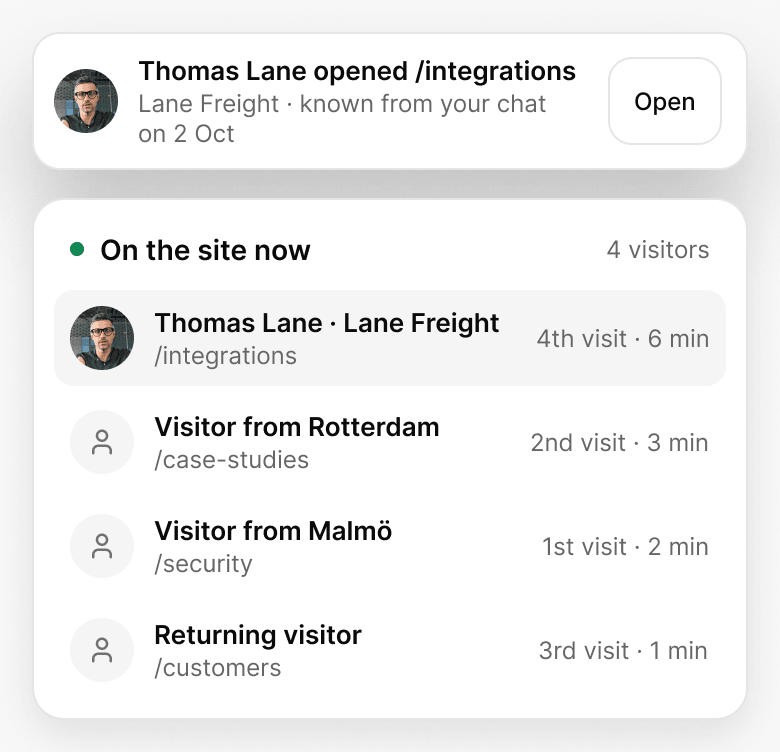
Your teamThomas is back for the fourth time this month, on the integrations page. Your team sees the page, the time on it and what he read before.
Lane Freight · 4th visit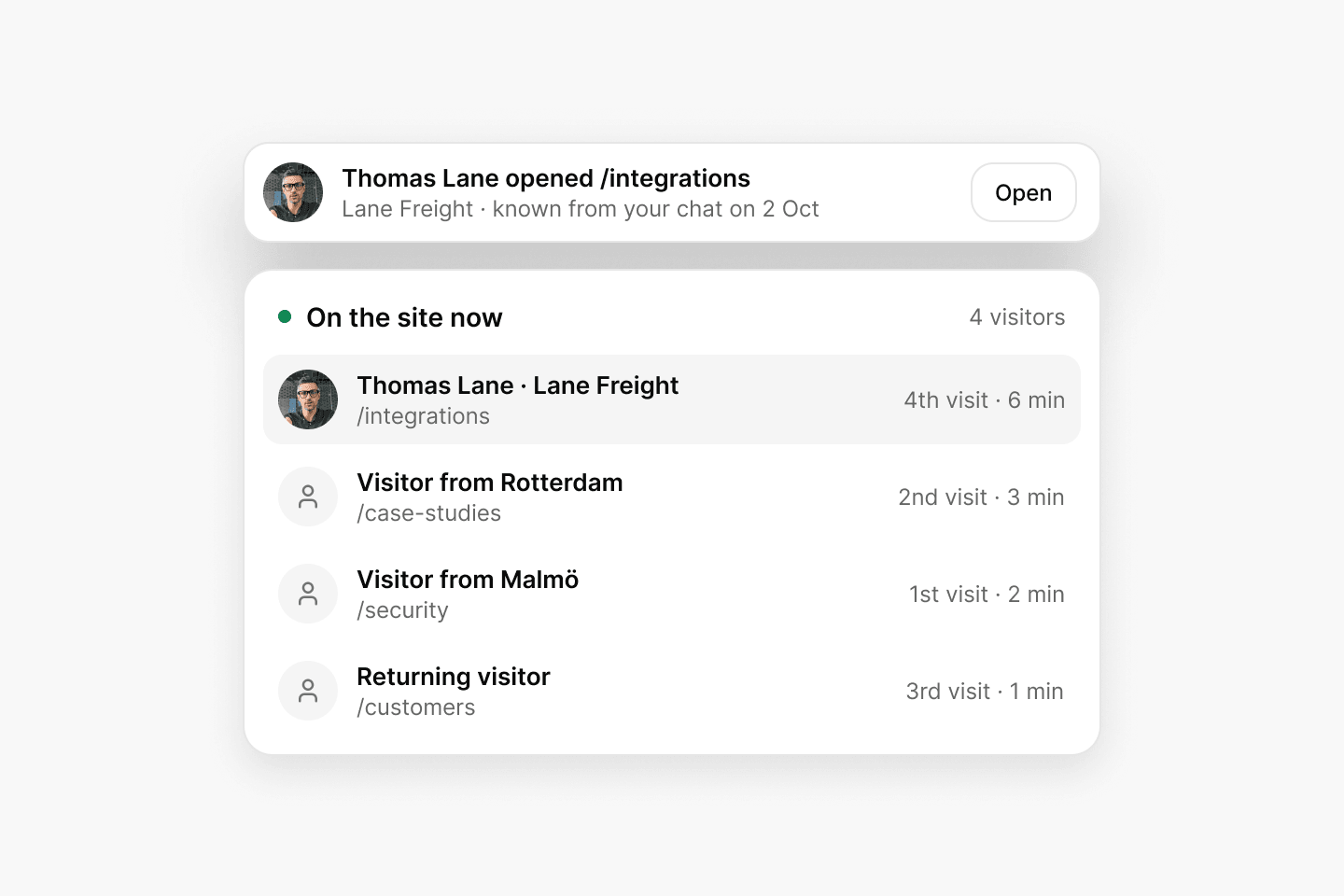
- Video · camera off
A video call about the TMS
BothThomas taps Talk now. Marcus answers on video; Thomas keeps his camera off, and Nadia adds a team note he never sees.
Video · camera off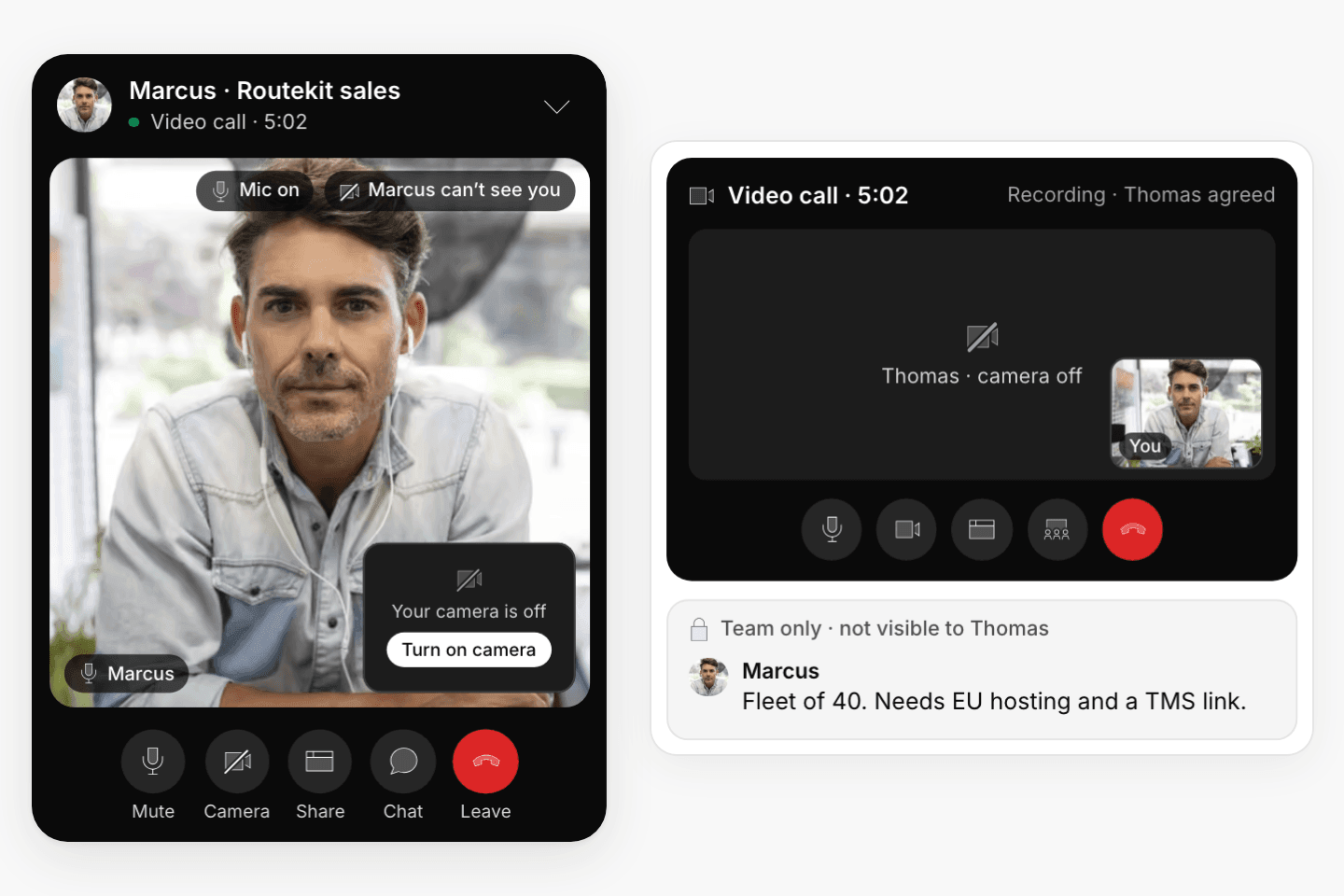
- Your TMS circled
The setting, circled on his page
BothWith Thomas's OK, Marcus sees the integrations page and circles Your TMS. He can point, not click, and the API key stays hidden.
Your TMS circled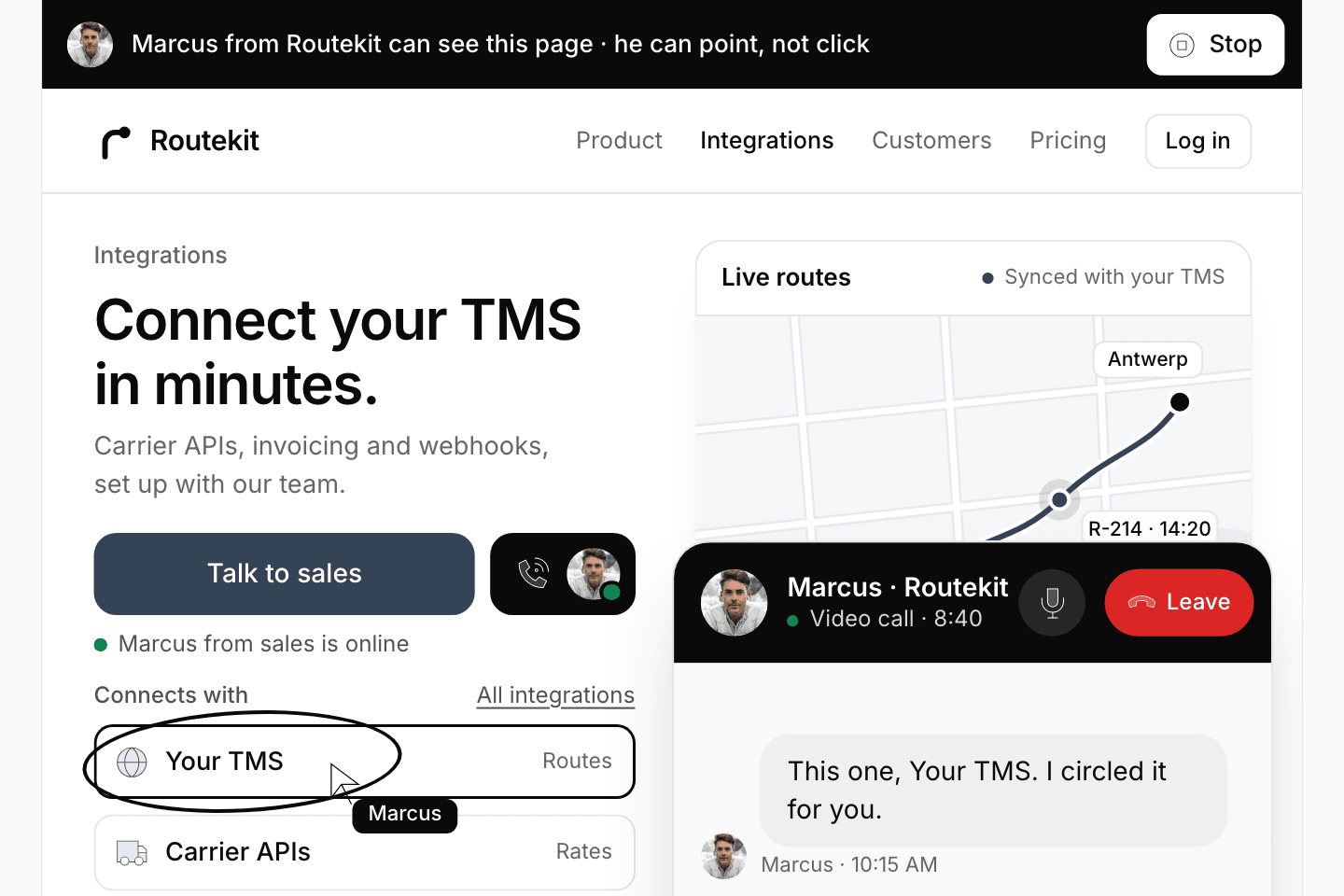


By Edvinas B., co-founder of GreetDock · Published · 3 min read
Key takeaways
- Logistics buyers come with a system to connect: a TMS, carrier APIs, invoicing.
- Greet the integrations page first, and have someone online who can answer the TMS question.
- Offer a call when the answer is a settings screen. Ask to see the page before you point.
- Keep fleet size, depots and dates on the record for the next call.
In this guide 5 chapters
What do logistics software buyers ask? Systems, carriers and rollout.
A transport or fleet manager reading your site is usually checking fit against what they run today:
- Does it connect to our TMS?
- Which carrier APIs do you support?
- Can we start with one depot?
- Who sets it up, and how long does it take?
Each answer depends on their setup, which a pricing table cannot know. A short conversation can.
In short: Make the TMS question one of the suggested questions in your integrations page greeting.
What slows a logistics software sale? Many systems, many people, little time.
- Integration questions that need someone technical, not a sales form.
- Operations people who prefer a call to typing.
- Several sites and time zones, so nobody is free when the buyer reads.
- Details from the first call lost by the time of the second.
In short: Plan for technical questions and buyers who prefer a call, and keep the record between calls.
How does a logistics sales team use GreetDock? Integrations page first.
- 01Greet /integrations with the TMS question
A greeting that names the page, with suggested questions such as Does it connect to our TMS?
- 02Keep someone technical in reach
The seller answers, and mentions a solutions engineer in a team note when the question goes deep.
- 03Offer a call for settings questions
Talk now while someone is taking calls. The buyer accepts in the tab and points the way they would in a meeting.
- 04Book the rollout call in the widget
When nobody is free, the buyer picks a time from your team's hours, with the thread attached.

In short: Greet the integrations page, keep an engineer one note away, and book a time when nobody is free.
What will their security team ask? Hosting, sharing and the DPA.
NIS2 lists transport among its sectors of high criticality, and asks those entities to manage supply chain security. Some of your buyers will pass that question on to you.
For the conversation tool on your own site, three answers usually settle it:
- GreetDock is hosted in the EEA. The ISO/IEC 27001:2022 certificate belongs to the hosting provider, not to GreetDock.
- A shared page shows no sensitive inputs, other tabs or desktop applications.
- The DPA is public, and the sub-processor register is available on request.
In short: Have three facts ready for the first security questions: EEA hosting, what a shared page hides, and the public DPA.
Is GreetDock a fit for your team? Worth knowing before you apply.
If one of those rules it out, our comparisons say which tool fits better.
A depot question, then a booked rollout call. Thomas wants to start with one depot.
Routekit and Lane Freight are fictional.
- 4:52 PMVisitorThomas reads Routekit's integrations page from the Dublin depot office.
- 4:55 PMVisitorHe asks whether one depot can go live before the others.
- 4:57 PMYour teamMarcus answers, and the call button offers Book a call, as nobody is taking calls.
- 4:59 PMGreetDockThomas books Thursday at 3:00 PM, and the booking joins his record.
Around the integrations page. In the private beta today.
- Return visits stand out
A fleet buyer back for the fourth time shows their visit count beside the page.
- Hours per team
Set the hours your team takes calls. Outside them, buyers book a time or leave a message.
- Point at the setting
On a shared page your team circles the field to fill. API keys and card inputs stay hidden.
Co-browsing - Paperwork for the review
EEA hosting, a public DPA and a sub-processor register on request.
Security
Before you greet freight buyers. What logistics sales teams ask.
The products behind it
- CallsA browser call from the integrations page.
- Co-browsingPoint at the setting, with consent.
- Booking & callbacksA booked call when nobody is free.
For sales teams: B2B sales, Conversations from your site, Questions before the call, Sales handoff
By industry: SaaS, Fintech, Cybersecurity, HR and payroll software
Other teams: Online stores, Support teams, Agencies
Comparing tools? GreetDock vs Drift, GreetDock vs Chili Piper